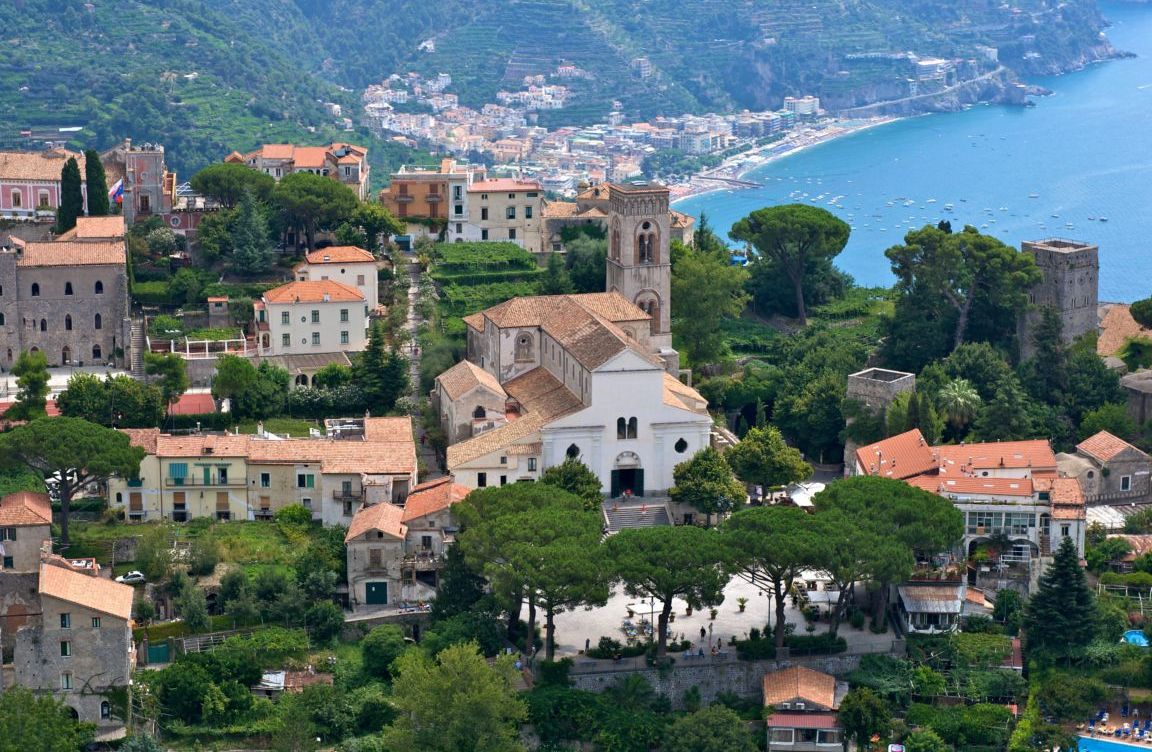

With origins going back to the 6th century, by the year 1000 it had attracted a group of nobles from the Amalfi who had rebelled against the authority of the Doge of the Maritime Republic. It was a good choice for a refuge, being easily defendable, perched between two steep river valleys and rising sheer from the sea.
The city quickly prospered, thanks in particular to a wool mill known as the “Celendra” granted by King Charles Il of Anjou to Bishop Giovanni Allegri on 23 April 1292, to its fine crops and the intense trade on the Mediterranean sea routes, especially with the Arabs and Byzantines. In 1086 it was appointed seat of a bishopric, and over the following century it established itself as a centre of power, with a population of 30,000 inhabitants.
By 1137 it was described by Bernardo da Chiaravalle as “…ancient, well fortified and impregnable, and not only opulent but so beautiful that it is surely to be numbered among the most noble of cities …”. The history of Ravello went hand in hand with that of the Maritime Republic. In the Norman period it entered into economic and political decline, and this became dramatic in the course of the seventeenth century. Having lost its prosperous economy, Ravello was left with what we are fortunate enough to enjoy today: its incomparable position, and architectural and artistic marvels created during its golden age.


